
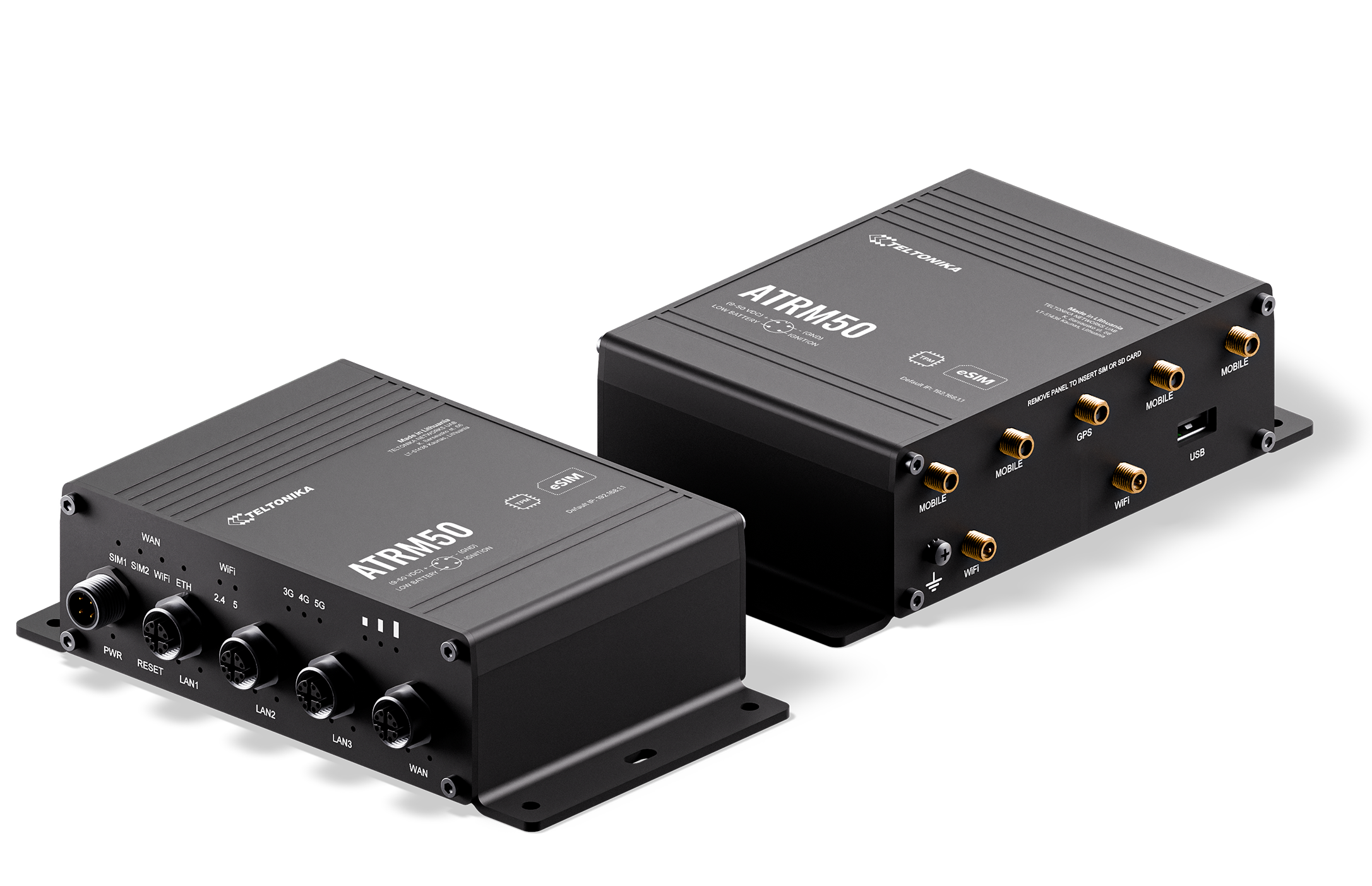

Teltonika ATRM50 – router
- Mobile module: 5G Sub-6 GHz SA, NSA 2.4, 3.4Gbps DL (4x4 MIMO) 900, 550Mbps UL (2x2 MIMO); 4G LTE: DL Cat 19 1.6Gbps (4x4 MIMO), UL Cat 18 200Mbps; 3G 42 Mbps (DL)/ 5.76 Mbps(UL)
- Wireless mode: 802.11b/g/n/ac Wave 2 (Wi-Fi 5) with data transmission rates up to 867 Mbps (Dual Band, MU-MIMO)
- Input voltage range: 9 - 50 VDC, reverse polarity protection, Overvoltage protection (70V), Surge protection >69 VDC 10us max
- Dimensions (W x H x D): 167 x 46.2 x 112.4 mm
- Operating temperature: -40 °C to 75 °C
Technical specifications
Mobile
| Mobile module | 5G Sub-6 GHz SA, NSA 2.4, 3.4Gbps DL (4x4 MIMO) 900, 550Mbps UL (2x2 MIMO); 4G LTE: DL Cat 19 1.6Gbps (4x4 MIMO), UL Cat 18 200Mbps; 3G 42 Mbps (DL)/ 5.76 Mbps(UL) |
|---|---|
| 3GPP Release | Release 16 |
| eSIM | Consumer type eSIM, profile download and removal operations, up to 7 eSIM profiles; does not include data plans |
| SIM switch | Dual sim cards and esim, auto-switch cases: weak signal, data limit, SMS limit, roaming, no network, network denied, data connection fail |
| Status | IMSI, ICCID, operator, operator state, data connection state, network type, CA indicator, bandwidth, connected band, signal strength (RSSI), SINR, RSRP, RSRQ, EC/IO, RSCP, data sent/received, LAC, TAC, cell ID, ARFCN, UARFCN, EARFCN, MCC, and MNC |
| SMS | SMS status/configuration; email, HTTP and SMS forwarding; scheduling, automatic replies and SMPP. |
| USSD | Send and read USSD messages. |
| Block/Allow list | Operator or country based block/allow lists. |
| Multiple PDN | Multiple PDNs for separate network connections and services. |
| Band management | Band locking and active-band display. |
| SIM idle protection service | Periodically connect through the unused SIM to reduce inactivity-related SIM blocking. |
| SIM PIN code management | Set, change or disable the SIM PIN. |
| APN | Auto APN |
| Bridge | Bridge the cellular provider connection to a LAN device. |
| Passthrough | Router assigns its mobile WAN IP address to another device on LAN |
| Framed routing | Framed routing: support an IP network behind 5G UE |
Wireless
| Wireless mode | 802.11b/g/n/ac Wave 2 (Wi-Fi 5) with data transmission rates up to 867 Mbps (Dual Band, MU-MIMO) |
|---|---|
| Wi-Fi security | WPA2-Enterprise: PEAP, WPA2-PSK, WPA-EAP, WPA-PSK, WPA3-SAE, WPA3-EAP, OWE; AES-CCMP, TKIP, Auto-cipher modes, client separation, EAP-TLS with PKCS#12 certificates, disable auto-reconnect, 802.11w Protected Management Frames (PMF) |
| SSID/ESSID | SSID stealth mode and access control based on MAC address |
| Wi-Fi users | Up to 150 simultaneous connections |
| Wireless Connectivity Features | Wireless mesh (802.11s), fast roaming (802.11r), Relayd, BSS transition management (802.11v), radio resource measurement (802.11k) |
| Wireless MAC filter | Allowlist, blocklist |
| Wireless QR code generator | Join Wi-Fi by scanning a QR code. |
| TravelMate | Forward Wi-Fi hotspot landing page to a subsequent connected device |
Ethernet
| WAN | 1 x WAN port 10/100/1000 Mbps, compliance with IEEE 802.3, IEEE 802.3u, 802.3az standards, supports auto MDI/MDIX crossover |
|---|---|
| LAN | 3 x LAN ports, 10/100/1000 Mbps, compliance with IEEE 802.3, IEEE 802.3u, 802.3az standards, supports auto MDI/MDIX crossover |
System Characteristics
| CPU | MediaTek, Dual-Core, 880 MHz, MIPS1004Kc |
|---|---|
| RAM | 256 MB, DDR3 |
| FLASH storage | 16 MB serial NOR flash, 256 MB serial NAND flash |
Input/Output
| Input | 2 x Inputs for Ignition Detection and Low Battery |
|---|---|
| Events | Email, RMS, SMS |
| I/O juggler | Trigger events from configurable I/O conditions. |
Power
| Connector | M12 A code 4 pin male |
|---|---|
| Input voltage range | 9 - 50 VDC, reverse polarity protection, Overvoltage protection (70V), Surge protection >69 VDC 10us max |
| Power consumption | Idle: < 5.5 W, Max: < 16 W |
Physical Interfaces
| Ethernet | 4 x M12 X code 8-pin female ports, 10/100/1000 Mbps |
|---|---|
| I/O’s | 2 x Input (Ignition detection/Low battery) |
| Status LEDs | 4 x WAN type, 3 x Mobile connection type, 3 x Mobile connection strength, 6 x LAN status, 2 x WAN status, 1 x Power, 2 x 2.4G and 5G Wi-Fi |
| SIM | 2 x SIM slots (Mini SIM - 2FF), 1.8 V/3 V |
| Power | 1 x M12 A code 4-pin male connector |
| Antennas | 4 x SMA for Mobile, 2 x RP-SMA for Wi-Fi, 1 x SMA for GNSS |
| USB | 1 x USB A port for external devices |
| Reset | Reboot/User default reset/Factory reset button |
| Other | 1 x Grounding screw |
Physical Specification
| Casing material | Anodised aluminium housing and panels |
|---|---|
| Dimensions (W x H x D) | 167 x 46.2 x 112.4 mm |
| Weight | 550 g |
| Mounting options | Flat surface |
Operating Environment
| Operating temperature | -40 °C to 75 °C |
|---|---|
| Operating humidity | 10% to 90% non-condensing |
| Ingress Protection Rating | IP30 |
Network
| Routing | Static routing, Dynamic routing (BGP, OSPF v2, RIP v1/v2, EIGRP, NHRP), Policy based routing |
|---|---|
| Network protocols | TCP, UDP, IPv4, IPv6, ICMP, NTP, DNS, HTTP, HTTPS, SFTP, FTP, SMTP, SSL/TLS, ARP, VRRP, PPP, PPPoE, UPNP, SSH, DHCP, Telnet, SMPP, SNMP, MQTT, Wake On Lan (WOL), VXLAN |
| VoIP passthrough support | NAT helpers for H.323 and SIP ALG. |
| Connection monitoring | Ping/Wget and periodic reboot; LCP/ICMP link checks. |
| Firewall | Port forwarding, traffic/custom rules and adjustable TTL targets. |
| Firewall status page | Firewall rules, counters and statistics in the status view. |
| Port management | Enable/disable ports; configure speed and auto-negotiation. |
| Network topology | Topology view of connected network devices. |
| Hotspot | Captive portal with internal/external RADIUS, RADIUS MAC, SMS and SSO authentication; internal/external landing page, walled garden, scripts, URL parameters, users/groups and limits; 9 editable themes with theme import/export. |
| Hotspot 2.0 | Hotspot 2.0 is a Wi-Fi standard that enables seamless, secure, and automatic connection to trusted wireless networks |
| DHCP | Static/dynamic allocation, DHCP relay/server, status and static MAC leases with wildcards. |
| QoS / Smart Queue Management (SQM) | Priority queues by source/destination, service, protocol or port; WMM and 802.11e. |
| DDNS | More than 77 preconfigured providers; additional providers configurable manually. |
| DNS over HTTPS | DNS proxy using HTTPS for encrypted DNS queries. |
| Network backup | Wi-Fi WAN, Mobile, VRRP, Wired options, each of which can be used as an automatic Failover |
| Load balancing | Balance Internet traffic over multiple WAN connections |
| SSHFS | Mount remote file systems through SSH. |
| VRF support | Initial virtual routing and forwarding (VRF) support |
| Traffic Management | Live traffic monitoring, radio-signal charts and usage history. |
Security
| Authentication | PSK, digital/X.509 certificates, TACACS+ and internal/external RADIUS; IP/login blocking, timed lockouts and random password generation. |
|---|---|
| Firewall | WebUI presets and CLI configuration; DMZ, NAT, NAT-T and NAT64. |
| Attack prevention | DoS protections for SYN flood, SSH and HTTP/HTTPS; scan detection for SYN-FIN, SYN-RST, X-mas, NULL and FIN. |
| VLAN | Port based and tagged VLAN separation. |
| Mobile quota control | Cellular data limits with period, start time, warning threshold and notification number. |
| WEB filter | Website blocklists and allowlists. |
| Access control | Access rules for SSH, WebUI, CLI and Telnet. |
| TPM | Identification and authentication module, TPM 2.0 standard |
| Certificate Manager | Create CA, server/client, Let’s Encrypt and SCEP certificates. |
VPN
| OpenVPN | Simultaneous server and multiple clients; 27 encryption options. |
|---|---|
| OpenVPN Encryption | DES-CBC 64, RC2-CBC 128, DES-EDE-CBC 128, DES-EDE3-CBC 192, DESX-CBC 192, BF-CBC 128, RC2-40-CBC 40, CAST5-CBC 128, RC2-64-CBC 64, AES-128-CBC 128, AES-128-CFB 128, AES-128-CFB1 128, AES-128-CFB8 128, AES-128-OFB 128, AES-128-GCM 128, AES-192-CFB 192, AES-192-CFB1 192, AES-192-CFB8 192, AES-192-OFB 192, AES-192-CBC 192, AES-192-GCM 192, AES-256-GCM 256, AES-256-CFB 256, AES-256-CFB1 256, AES-256-CFB8 256, AES-256-OFB 256, AES-256-CBC 256 |
| IPsec | XFRM, IKEv1, IKEv2, with 14 encryption methods for IPsec (3DES, DES, AES128, AES192, AES256, AES128GCM8, AES192GCM8, AES256GCM8, AES128GCM12, AES192GCM12, AES256GCM12, AES128GCM16, AES192GCM16, AES256GCM16) |
| GRE | GRE and GRE over IPsec tunnels. |
| PPTP, L2TP | Concurrent client/server instances; L2TPv3 and L2TP over IPsec. |
| Stunnel | TLS proxy for existing client/server applications. |
| DMVPN | Scalable IPsec VPN: phase 2, phase 3 and dual-hub operation. |
| SSTP | SSTP client. |
| ZeroTier | ZeroTier client. |
| WireGuard | WireGuard client and server. |
| Tinc | Tinc client/server with encryption, authentication and compression. |
| Tailscale | Tailscale encrypted point-to-point VPN using WireGuard. |
BacNET
| Supported modes | Router |
|---|---|
| Supported connection types | IP, RTU (USB) |
| Configuration options | Multiple BACnet/IP interfaces, network-number assignment and preset BDT entries for BBMD. |
OPC UA
| Supported modes | Client, Server |
|---|---|
| Supported connection types | TCP |
MODBUS
| Supported modes | Server, Client |
|---|---|
| Supported connection types | TCP, USB |
| Custom registers | File backed custom Modbus TCP register blocks for read/write requests. |
| Supported data formats | 8-bit: INT, UINT; 16-bit: INT, UINT (MSB or LSB first); 32-bit: float, INT, UINT (ABCD (big-endian), DCBA (little-endian), CDAB, BADC), HEX, ASCII |
Data to Server
| Protocol | HTTP(S), MQTT, Azure MQTT |
|---|---|
| Data to server | Collect parameters across sources/protocols and transmit to one server; custom Lua scripts supported. |
MQTT Gateway
| Modbus MQTT Gateway | Read Modbus-server data and send commands through an MQTT broker. |
|---|
DNP3
| Supported modes | Station, Outstation |
|---|---|
| Supported connection | TCP, USB |
DLMS/COSEM
| DLMS Support | Utility-meter data exchange using DLMS. |
|---|---|
| Supported modes | Client |
| Supported connection types | TCP |
API
| Teltonika Networks Web API (beta) support | Configurable API endpoints to read/change device data; developer documentation available. |
|---|
Site Manager
| Supported modes | Manager |
|---|---|
| Functionalities | Manage TAP access points and Teltonika managed switches: pairing/grouping, FOTA, status, scheduled reboot with ping/Wget checks, SSIDs and VLANs. |
Monitoring & Management
| WEB UI | HTTP/HTTPS administration: status, settings, firmware, CLI, diagnostics, remote/event/system/kernel logs and update notifications. |
|---|---|
| FOTA | Server based firmware updates with notifications. |
| SSH | SSH (v1, v2) |
| SMS | Status and configuration by SMS. |
| Call | Reboot, Status, Mobile data on/off, Output on/off, answer/hang-up with a timer, Wi-Fi on/off |
| Receive email message status alerts of various services | |
| TR-069 | OpenACS, EasyCwmp, ACSLite, tGem, LibreACS, GenieACS, FreeACS, LibCWMP, Friendly tech, AVSystem |
| MQTT | MQTT Broker, MQTT publisher |
| SNMP | SNMP (v1, v2, v3), SNMP Trap, Brute force protection |
| JSON-RPC | Management API through HTTP/HTTPS. |
| RMS | Teltonika Remote Management System (RMS) |
IoT Platforms
| ThingWorx | Monitor WAN type/IP, operator, cellular signal and network type. |
|---|---|
| Cumulocity - Cloud of Things | Monitor device/revision/serial, WAN, cell ID, ICCID/IMEI, connection, operator and signal; remote reboot and firmware updates. |
| Azure IoT Hub | Cloud telemetry through Data to Server; RutOS API direct methods; Plug and Play with Device Provisioning Service. |
| AWS IoT Core | AWS IoT integration with device API calls through AWS Jobs. |
Firmware/Configuration
| WEB UI | Local/server firmware update, configuration profiles and backups. |
|---|---|
| FOTA | Firmware update. |
| RMS | Batch firmware/configuration updates for multiple devices. |
| Keep settings | Retain configuration during firmware updates. |
| Factory settings reset | Restore manufacturer defaults, including IP, PIN and user data settings. |
FIRMWARE CUSTOMISATION
| Operating system | RutOS (OpenWrt based Linux OS) |
|---|---|
| Supported languages | Busybox shell, Lua, C, C++, and Python, Java in Package manager |
| Development tools | SDK with build environment. |
| GPL customization | Customize firmware branding, colours, logos and web applications. |
| Package Manager | Install additional software packages on the device. |
Location Tracking
| GNSS | GPS, GLONASS, BeiDou, Galileo and QZSS |
|---|---|
| Coordinates | GNSS coordinates via WebUI, SMS, TAVL, RMS |
| NMEA | NMEA 0183 |
| NTRIP | NTRIP protocol (Networked Transport of RTCM via Internet Protocol) |
| Server software | Supported server software TAVL, RMS |
| Geofencing | Configurable multiple geofence zones |
USB
| Data rate | USB 2.0 |
|---|---|
| Applications | Samba share, USB-to-serial |
| External devices | Possibility to connect external HDD, flash drive, additional modem, printer, USB-serial adapter |
| Storage formats | FAT, FAT32, exFAT, NTFS (read-only), ext2, ext3, ext4 |
SD CARD
| Physical size | Micro SD (internal) |
|---|---|
| Applications | Samba share |
| Capacity | Up to 2 TB |
| Storage formats | FAT32, NTFS, ext2, ext3, ext4 |
Package contents and ordering versions
The manufacturer lists the following standard package; the complete order code can specify different contents:
- ATRM50 Router
- Hex key
- QSG (Quick Start Guide)
- Packaging box
| Hardware / regional version | ATRM50 1***** EMEA¹, APAC, Brazil |
|---|---|
| Frequencies | 5G NR NSA: n1, n3, n5, n7, n8, n20, n28, n38, n40, n41, n71, n75, n76, n77, n78 5G NR SA: n38, n40, n41, n77, n78 4G (LTE-FDD): B1, B3, B5, B7, B8, B20, B28, B32, B71 4G (LTE-TDD): B38, B40, B41, B42, B43 3G: B1, B5, B8 |
| Order code / configuration | ATRM50100000 / Standard package ATRM50100200 / Standard package with M12 X type 8-pin male connector and M12 A type 4-pin female connector ATRM50100300 / Mass packing code |
- 1 - Regional availability - excluding Russia, Belarus & Iran
Accessories with manufacturer-listed compatibility
Check connector, regional version and any limitations on the accessory page.
- Teltonika PR3PDNP0 – DIN Rail Power Supply, 20 W, 12 V
- Teltonika PR1CS530 – 5G Straight Compact Mobile SMA Antenna
- Teltonika PR2VM20M – SMA Cable Extension
- Teltonika PR1KC647 – 5G Combo MIMO Mobile Roof SMA Antenna
- Teltonika PR1KCI49 – 5G Combo MIMO Mobile/GNSS Roof SMA Antenna
- Teltonika PR1KSG30 – GNSS Adhesive SMA Antenna
- Teltonika PR14RD35 – Wi-Fi Dual-Band SMA Antenna
- Teltonika PR1KRD30 – Wi-Fi Dual-Band Magnetic SMA Antenna
- Teltonika PR1US540 – 5G Mobile SMA Antenna
- Teltonika PR1KS536 – 5G Mobile Magnetic SMA Antenna
- Teltonika PR40119K – M12 A Type 4-Pin Female Connector
- Teltonika PR40118K – M12 X Type 8-Pin Straight Male Connector
- Teltonika PR5MEC19 – Sim Adapter Kit
Documentation and downloads
- Manufacturer page, datasheet and downloads
- Measurements and 3D models
- Quick start guide
- Firmware-Downloads
- User manual
- Certifications and approvals
- Manufacturer knowledge base
- Software Development Kit
- GPL-Downloads
- Manufacturer knowledge base
- API developer documentation
Technical information checked against the linked manufacturer page on 17 October 2026. Radio bands, approvals and package contents can depend on the full order code and region. Software features depend on firmware, configuration and any additional packages or licences. Price and availability are confirmed on enquiry.
Reviews
There are no reviews yet.